About AI Down
AI Down is a free, public-facing tool that aggregates real-time status and outage data for 50+ AI and LLM providers across 7 ecosystem strata. Think "Downdetector for AI" — with supply chain correlation, cross-provider cascade detection, and a cybersecurity-informed dependency graph.
Why This Exists
- "Is ChatGPT down" gets ~90K monthly searches — yet there's no single dashboard for the entire AI ecosystem.
- Status pages lag reality by 15-45 minutes. We use synthetic API probes every 60 seconds to detect outages faster.
- Downdetector uses binary up/down. AI services are more nuanced: the API can be up while the web app is down, or a specific model can be degraded.
- No other tracker maps AI failures to shared infrastructure. When AWS goes down, which AI providers are affected? We show that.
How We Monitor
We combine three signal sources:
- Official Status Pages — Atlassian Statuspage JSON APIs, AWS Health Dashboard, Azure RSS, GCP incident feeds.
- Synthetic API Probes — We send lightweight requests through OpenRouter to 20+ models every 1-5 minutes, measuring response time and Time to First Token.
- Crowdsourced Reports — Users can report issues directly from each provider page, helping us detect problems before official acknowledgment.
How We Measure AI Availability
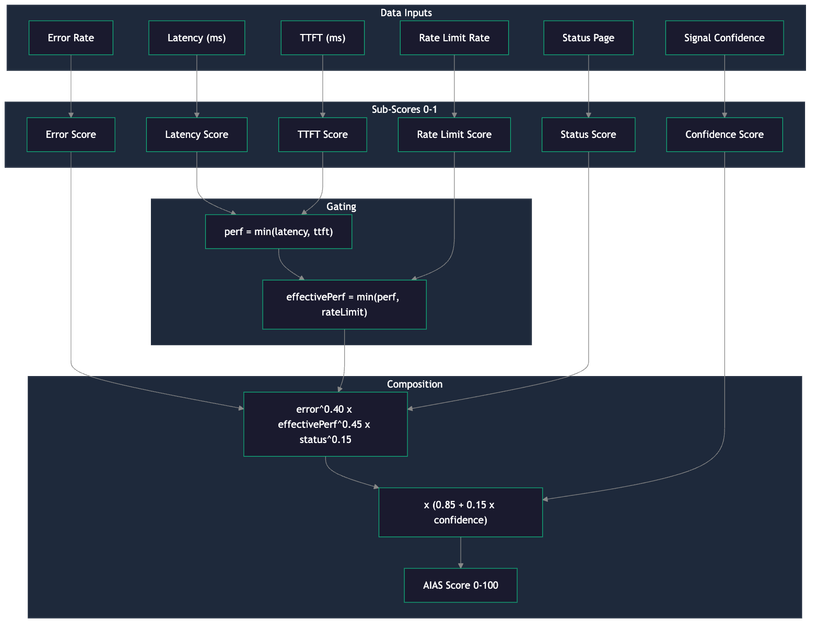
Status pages report binary up/down. We measure a spectrum. The AI Intelligence Availability Score (AIAS) combines six dimensions — latency, time-to-first-token, error rate, rate limiting, official status, and data confidence — into a single 0–100 score for each provider. Scores are relative to each provider's historical baseline: a 2-second response from GPT-4o is normal, but from Groq it indicates severe degradation.
The AI Health Index (AIHI) aggregates individual provider scores into an ecosystem-wide metric, showing whether AI intelligence is generally available right now.
The scoring methodology is published as an open specification: AI Availability Score — Methodology.
Built By SecureCoders
SecureCoders is a cybersecurity firm specializing in penetration testing, virtual CISO services, and AI security assessments. We built AI Down to demonstrate our monitoring expertise and provide genuine value to the developer community.
Open Data
Our public API is free for up to 100 requests per day. Developers can integrate AI provider status data into their own dashboards, alerting systems, and applications.